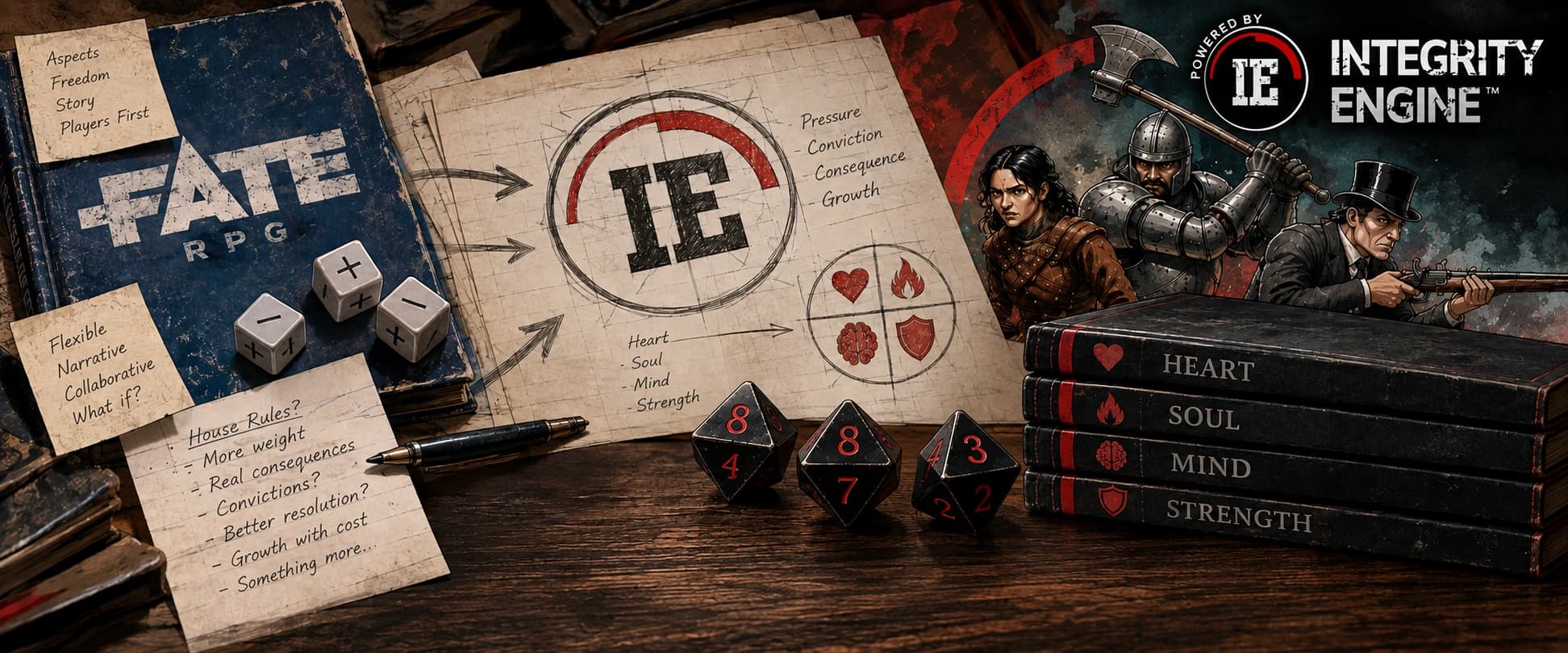
From Fate to Integrity
On this page
Why We Built Our Own Engine at Open Almond Studios#
When Open Almond Studios first began publishing games, we built on the Fate RPG. That was a deliberate choice. Fate is flexible, narrative-first, and gives players considerable freedom to define who their characters are and what matters to them. It gave us an excellent foundation while we learned what kinds of games we actually wanted to make.
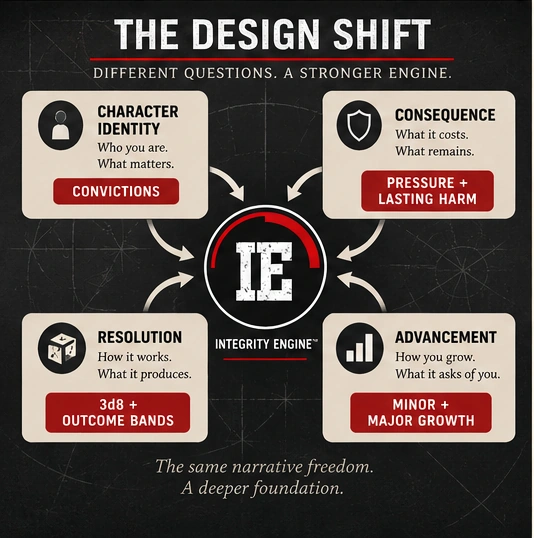
Over time, though, our games began asking questions Fate was not really designed to answer. We wanted hardship to leave meaningful consequences. We wanted convictions to matter mechanically when following them became costly. We wanted advancement to represent genuine growth without simply erasing everything a character had endured.
 View larger
The more we pushed in those directions, the more of the underlying system we replaced.
Eventually, we had to admit that we were no longer modifying Fate.
We were building something else.
What Changed?#
The Integrity Engine still values narrative freedom and player agency, but its mechanics are built around pressure, consequence, conviction, and growth.
| Fate gave us... | Integrity Engine developed... |
|---|---|
| Narrative-first play | Narrative choices tied directly to mechanical consequence |
| Character-defining traits | Heart, Soul, Mind, and Strength as core Pillars |
| Stress and consequences | Pressure and Lasting Harm |
| Fate Points | Integrity earned through costly tests of Conviction |
| Flexible success | Failure, Endured Success, Success, Edge Success, and Critical Success |
| Advancement | Minor Growth and milestone-based Major Growth |
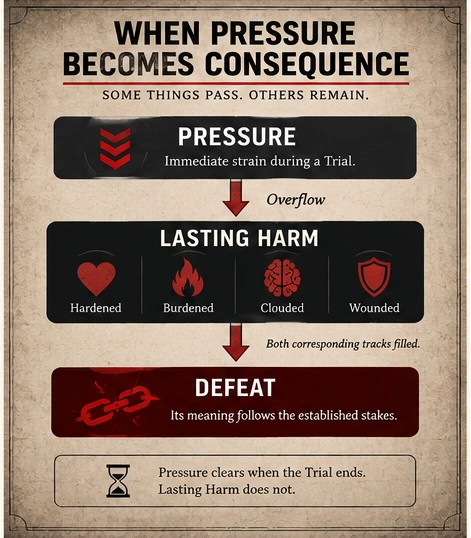
One of the largest changes was separating Pressure from Lasting Harm. Pressure represents what a character is carrying during the immediate Trial. If that pressure exceeds what they can bear, it spills into lasting consequences: Heart may become Hardened, Soul Burdened, Mind Clouded, or Strength Wounded. If both tracks for a Pillar fill, the character suffers Defeat, with the established stakes determining what that means.
 View larger
The dice changed too. Integrity Engine now uses 3d8, giving results a stronger middle and making ordinary competence more dependable. The broader outcome ladder lets us distinguish between barely enduring a challenge, succeeding cleanly, gaining additional leverage, and accomplishing something extraordinary. Successful matching dice can also generate Impact Points, allowing an action to affect the situation beyond simple success or failure.
Conviction Became Part of the Engine#
Perhaps the most important change was making a character's convictions mechanically relevant.
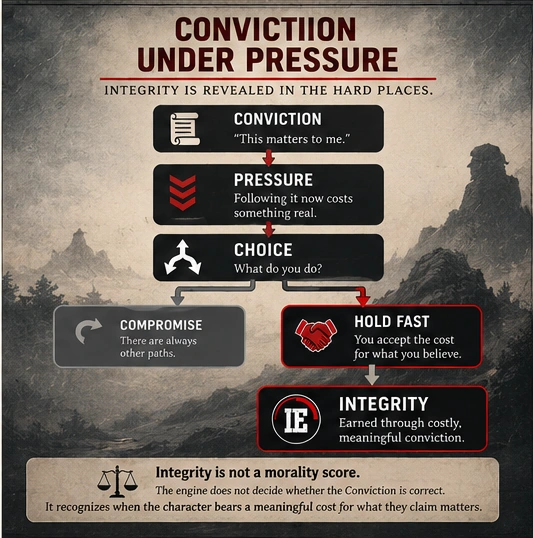
Characters record beliefs, commitments, duties, and principles that matter to them. When one of those Convictions is genuinely tested and the character accepts a meaningful cost to remain faithful to it, they can gain Integrity.
 View larger
That is intentionally different from a morality system. The rules do not decide whether a character holds the “correct” belief. They care about whether the character's stated convictions actually survive contact with difficulty.
Integrity is revealed when what a character claims to believe is placed under pressure.
That principle began with the needs of Warriors of the Covenant, but it proved useful far beyond a biblical setting. Conviction, sacrifice, responsibility, and consequence can matter in ancient history, dystopian futures, deep space, or almost anywhere else.
Growth Without Erasure#
Advancement changed for the same reason.
Minor Growth allows characters to refine themselves through ordinary play, while Major Growth marks meaningful story milestones and advances their Tier. Growth can change Skills, Disciplines, Convictions, and overall capability, but it does not automatically erase Lasting Harm.
We wanted becoming stronger to mean gaining greater capacity, not becoming untouched by everything that came before.
Why Integrity Engine Exists#
We did not leave Fate because Fate failed. It did what it was designed to do, and it taught us a great deal about narrative roleplaying.
We simply reached a point where the games we wanted to make required different assumptions underneath them.
The Integrity Engine grew from that need: consequences with weight, convictions that matter under pressure, cooperation grounded in the fiction, and growth that does not erase what a character has endured.
That is how we went from Fate to Integrity.
Somewhere along the way, a collection of house rules became an engine of its own.
Keep Reading
Stay with this thread a little longer
If this post connected with you, the best next step is usually to follow the author, open the closest topic tag, or head back to the main blog stream for the next article.
From this author
More from Benjamin Schmidt
Browse the rest of this author's published work and profile notes.
Follow the topic
Explore Studio
Jump into other posts that share the same theme, subject, or line of thought.
Don't miss the next one
Join the newsletter
Get new posts, release notes, and line updates without having to keep checking back manually.
About the Author

Benjamin Schmidt
Founder
Benjamin Schmidt is the founder of Open Almond Studios, LLC, a Christian tabletop game studio dedicated to Scripture-grounded storytelling. A U.S. Air Force cyber professional and lifelong student of the Bible, he designs games that emphasize faithfulness, integrity, and moral courage. He is the creator of Warriors of the Covenant™ and Legacy of the Remnant™, building systems that aim to shape hearts as much as they entertain.
Follow Benjamin