
Theology
The Bible and the Test of Time
On this page
Among the writings of antiquity, the Bible stands apart for the breadth, age, and diversity of the evidence that survives around it. The Hebrew Scriptures are represented by the Dead Sea Scrolls and later manuscript traditions that can be compared across many centuries. The New Testament survives in thousands of catalogued Greek witnesses, from small early papyri to major codices containing the complete New Testament. Archaeology adds inscriptions, cities, rulers, titles, and material settings that repeatedly intersect with the biblical record. In that cumulative sense—manuscript abundance, chronological depth, geographic reach, and historical corroboration—the Bible is the most extensively documented body of literature to come down to us from antiquity.
That abundance matters because the Christian faith does not rest on a text that disappeared into an inaccessible past. Transmission can be examined. Manuscripts can be compared. Historical settings can be tested against inscriptions, cities, rulers, and material culture. Prophetic texts can be placed beside later history. None of these lines of evidence exists in isolation; together they form a remarkably dense documentary record around Scripture.
The Manuscript Tradition: Documentation on an Exceptional Scale#
The first question for any ancient text is whether we possess enough surviving evidence to know what was transmitted. Here the Bible is unusually strong. Scholars can examine not merely one late copy, but large families of manuscripts spanning different periods, regions, scribal traditions, and languages. This does not make textual criticism unnecessary; it is precisely what makes textual criticism possible at such depth.
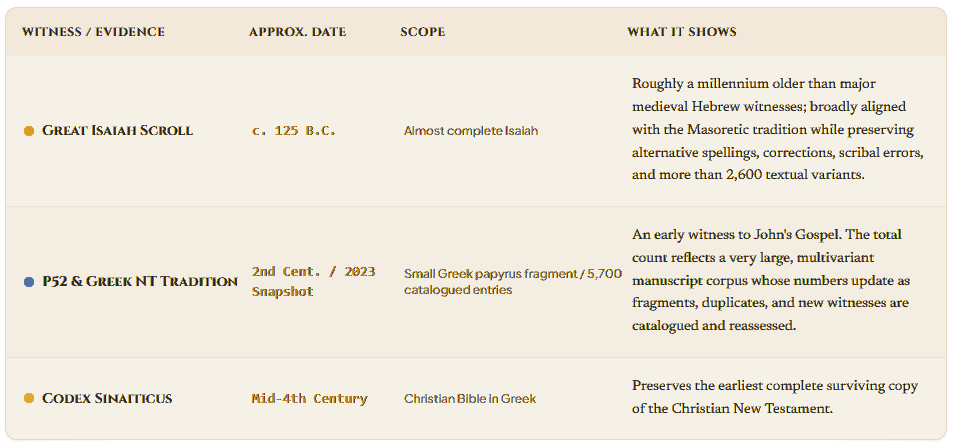
For the Old Testament, the discovery of the Dead Sea Scrolls beginning in 1947 transformed the evidence available to scholars. The Great Isaiah Scroll, dated by the Israel Museum to about 125 B.C., is roughly a thousand years older than the medieval Hebrew manuscripts that had previously supplied our oldest major witnesses to Isaiah.1 The museum notes that its text generally agrees with the later Masoretic tradition while also preserving alternative spellings, corrections, scribal errors, and more than 2,600 variants. That is not a weakness in the documentary case; it is the reason the case can be tested. We can place a nearly complete copy of Isaiah from before the time of Christ beside medieval Hebrew witnesses and see both continuity and variation across roughly a millennium of transmission.
The New Testament is documented even more densely. In 2023, the Institute for New Testament Textual Research (INTF) reported 5,700 catalogued entries in its Kurzgefasste Liste of Greek New Testament witnesses; the total changes as fragments are joined, duplicates removed, lost manuscripts reassessed, and new witnesses identified.2 Among the early witnesses is P52, a second-century fragment of John.3 By the fourth century, Codex Sinaiticus preserves the earliest complete surviving copy of the Christian New Testament.4 The result is not a single fragile chain of transmission, but a broad manuscript tradition that scholars can compare across centuries.
Few ancient textual traditions offer this degree of direct comparison. The differences are visible because the evidence is abundant. The Dead Sea Scrolls let scholars compare early Hebrew forms of biblical books with later traditions, while thousands of New Testament witnesses give textual critics an exceptionally rich field of evidence for tracing how the text was copied and preserved.
 View larger
Taken together, these witnesses show why the biblical text is so well documented: large numbers, early evidence, major complete codices, and enough surviving material to expose the history of transmission rather than conceal it.
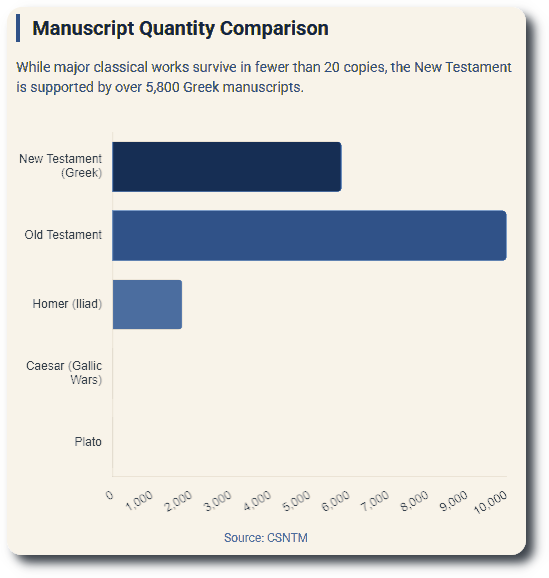
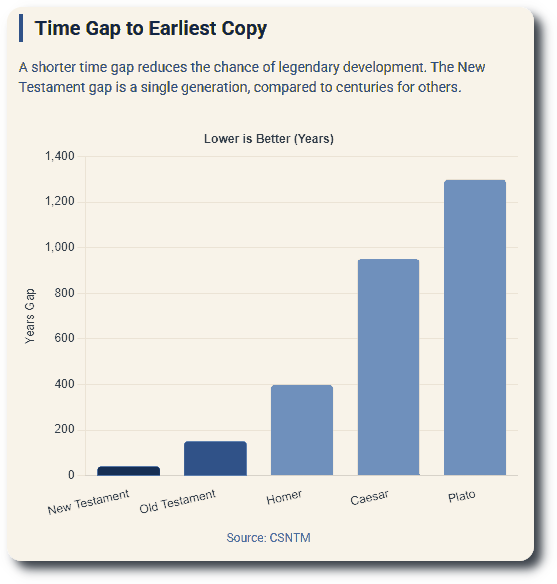
Because the New Testament tradition is both large and multivariant, editors can compare readings across thousands of Greek witnesses and many additional witnesses in other languages. That is precisely the strength of the documentary record: textual variants are not hidden behind a lost chain of copies; they are exposed to comparison. Critical editions can identify, evaluate, and print those differences openly. The strongest claim is therefore not a slogan about a universal percentage, but the far more substantial fact that the New Testament is exceptionally well attested and unusually open to textual verification.5
Objection: "Does having lots of copies prove the stories aren't made up?"
Response: Manuscripts first answer the transmission question—and on that question the evidence is formidable. The "telephone game" objection fails because the biblical text was not transmitted through one invisible chain that must simply be trusted. We possess many overlapping witnesses that can be compared. Archaeology then supplies a second line of evidence by testing the historical world described in the text, while prophecy and the theological claims of Scripture form further parts of the cumulative case.
Archaeological Confirmation: Silence No More#
Archaeology gives the biblical record another kind of documentation: physical points of contact with the world its authors describe. Inscriptions preserve names and titles. Excavated cities establish political and cultural settings. Tombs, monuments, and administrative records place biblical figures within the material world of antiquity. These discoveries do not replace the text; they repeatedly show that the biblical writers were speaking about an identifiable historical landscape.
 View larger
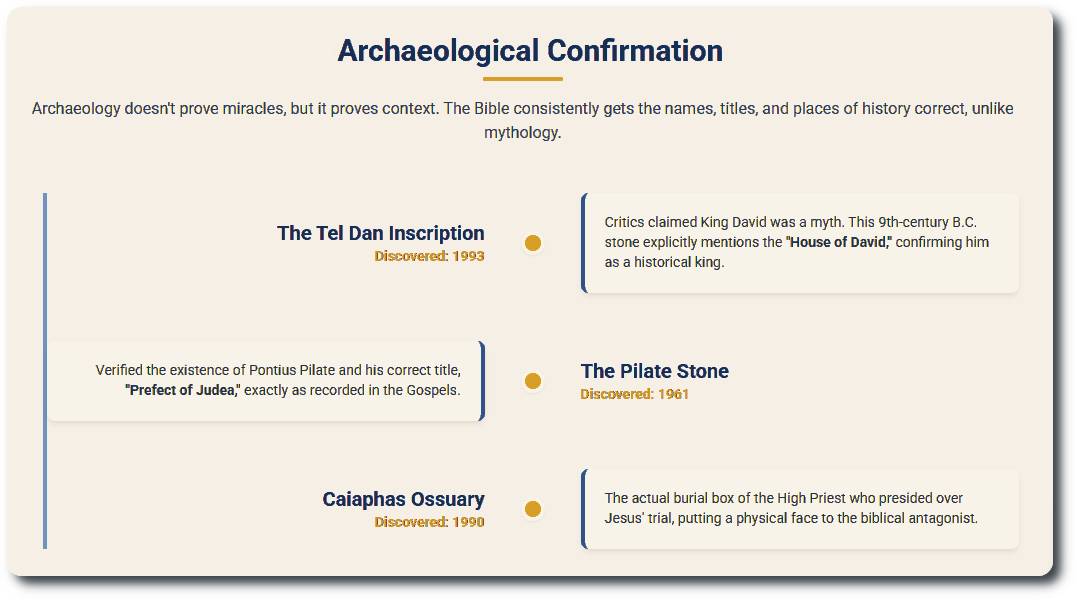
The Tel Dan Stele, discovered beginning in 1993, is a 9th-century B.C. Aramaic victory inscription containing the earliest known reference to the royal "House of David" outside the Hebrew Bible.6 That matters because it places the Davidic dynasty in the vocabulary of Israel's neighbors within roughly two centuries of David's traditional period. What had often been treated as merely a biblical dynastic claim appears in an independent royal inscription.
- The Pilate Inscription: Excavators found this Latin inscription in the theater at Caesarea in 1961. It names Pontius Pilate and preserves his title as praefectus Iudaeae ("prefect of Judea")—providing direct archaeological evidence for the Roman official known from literary sources, including the Gospels.7
- The Caiaphas Ossuary: The Israel Museum identifies an ornate ossuary from a Jerusalem family tomb bearing the name "Joseph bar Caiaphas" with the high priest Caiaphas, who served in the first century and appears in the New Testament passion narratives.8 It places a named figure from the Gospel setting within the archaeology of first-century Jerusalem.
- The Hittite Empire: Hattusha is firmly established archaeologically as the capital of the Hittite Empire, a major power in Anatolia and northern Syria during the second millennium B.C.9 The Hittites belong to the documented political world of the ancient Near East, not to a legendary landscape invented by the biblical writers.
The Prophetic Fingerprint#
Biblical prophecy adds a different kind of evidence to the case for Scripture. The historical task is to establish what the text says, when it existed, and what later events occurred; the Christian claim is that some of those correspondences are best explained as genuine fulfillment. The documentary strength of the Bible matters here because prophecy is not being reconstructed from a vanished text. Ancient manuscripts allow the prophetic writings themselves to be placed within history and compared with events that followed.
The Case of Tyre (Ezekiel 26)#
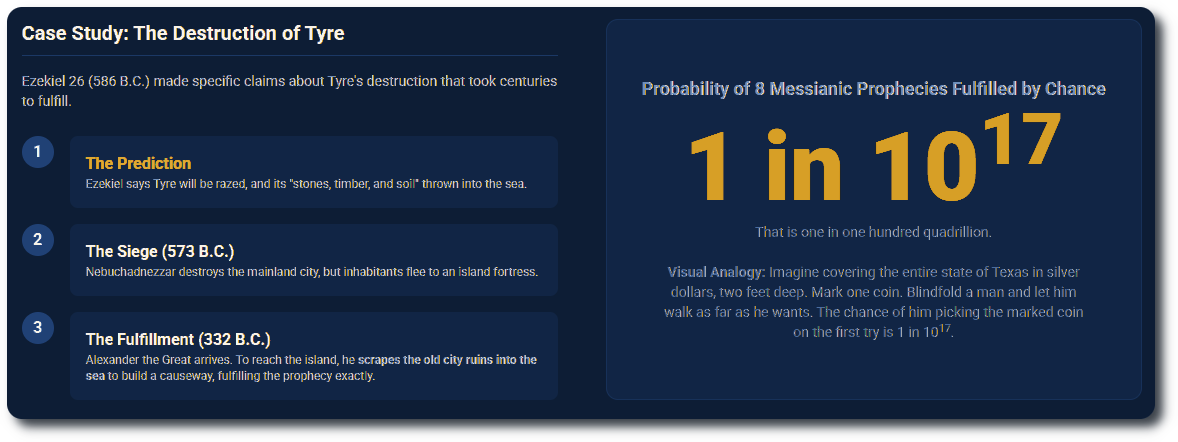
Ezekiel 26 describes judgment on Tyre, including the striking image of its stones, timber, and soil being cast into the water. Christian interpreters have long compared that language with the later history of the city, particularly Alexander the Great's siege in 332 B.C.10
- The Historical Correspondence: During Alexander's siege, he occupied Old Tyre on the mainland and built a causeway to the island city using rocks, timber, and rubble from the old city's buildings. UNESCO likewise notes that Alexander blocked the strait with a dike and that the former island is now a promontory.11 The correspondence with Ezekiel's imagery—Tyre's material cast into the water—is striking. The historical data establish the event; the Christian argument is that Ezekiel's earlier words illuminate it as fulfillment.
 View larger
Messianic Specificity#
Christian readers have long recognized a web of Old Testament passages that converge in the identity and work of the Messiah: Davidic kingship, Bethlehem, betrayal, suffering, rejection, and piercing among them. The exact number varies according to how direct prophecy, typology, and messianic patterns are counted, so the case is strongest when the texts themselves are examined rather than resting on a slogan such as "300 prophecies." Likewise, Rome did not invent crucifixion, but it developed and systematized the punishment in the period in which the New Testament is set.12 Peter Stoner's famous 1 in 10 to the 17th illustration for eight prophecies is best used as an apologetic illustration of cumulative specificity rather than as a laboratory-derived probability.13 The substantial argument lies in the convergence of the biblical texts themselves.
Internal Evidence: The Criterion of Embarrassment#
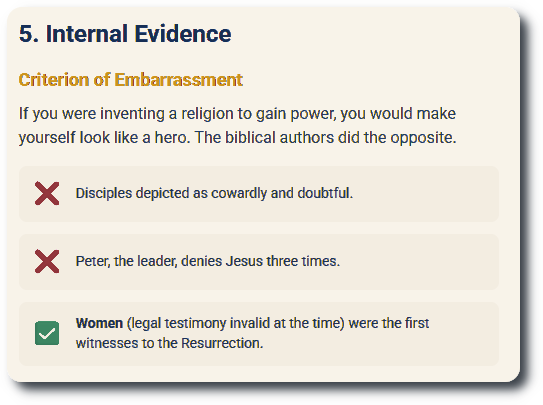
The Gospels also contain the kind of material ancient propagandists normally had reason to soften. The disciples repeatedly misunderstand Jesus; Peter denies him; the disciples flee; and women stand at the center of the empty-tomb tradition. Historians often discuss such material under the criterion of embarrassment: details that are inconvenient to a movement's self-presentation can carry evidential weight because they are less obviously invented for prestige.14
The criterion must be used with care, and the legal status of women's testimony in first-century Judaism was more complex than the common slogan suggests.15 Even so, the pattern remains notable: the Gospel writers consistently preserve failure, fear, doubt, and socially awkward witnesses rather than rewriting their founders into flawless heroes.
 View larger
Unity and Endurance#
The Bible is a library of writings—law, poetry, wisdom, prophecy, narrative, Gospels, and letters—produced and transmitted across many centuries. The Hebrew Bible is written primarily in Hebrew with portions in Aramaic; the New Testament is written in Greek. Its books arise from different periods, social settings, genres, and human voices, yet Christians have always read them as one unfolding redemptive history culminating in Christ.16 That unity is not established by a mathematical formula; it is encountered in the repeated themes, covenants, promises, judgments, deliverances, and messianic expectations that bind the canon together. The documentary breadth of Scripture makes that claim more, not less, remarkable: this is not one author's carefully controlled volume, but a library whose coherence emerges across centuries.
 View larger
Finally, there is the history of Scripture's survival. During the Great Persecution, Emperor Diocletian ordered Christian churches and scriptures destroyed in A.D. 303.17 Yet Christian texts continued to be copied, preserved, translated, and circulated. The Bible's endurance is therefore not merely devotional rhetoric; it is part of the documentary history itself. Manuscripts survived persecution, political upheaval, geographic dispersal, language change, and the ordinary hazards that destroyed most ancient books.
Conclusion: A Trustworthy Word#
The case for Scripture is cumulative. Its manuscripts give us extraordinary access to the history of the text. Archaeology repeatedly places biblical names, offices, cities, dynasties, and cultures within the material world of antiquity. Prophetic texts can be read beside later events. The Gospels preserve uncomfortable details rather than polishing their witnesses into legend. And across a library formed over centuries, Christians encounter a coherent redemptive story centered on Christ.
No single artifact carries the whole case. Together, however, the evidence shows that biblical faith is rooted in an unusually well-documented textual and historical record. The Bible has not survived by escaping scrutiny; it has survived while inviting it. As Isaiah wrote:
The grass withers, the flower fades; but the word of our God stands forever.”
Footnotes#
-
Israel Museum, Jerusalem. The Great Isaiah Scroll Overview. ↩
-
Institute for New Testament Textual Research (INTF). Current Greek manuscript counts and limitations (Kurzgefasste Liste). ↩
-
Center for the Study of New Testament Manuscripts (CSNTM). P52 Papyrus Data and Paleography. ↩
-
Codex Sinaiticus Project. About Codex Sinaiticus & Mid-4th Century Heritage. ↩
-
Society of Biblical Literature (SBL). Editing the Bible: Textual Criticism Standards. ↩
-
The Israel Museum. Tel Dan Stele (9th Century B.C.). ↩
-
Joan E. Taylor, New Testament Studies. Discussion of the Pilate Inscription from Caesarea. ↩
-
Israel Museum. Caiaphas Ossuary discovery and first-century Jerusalem context. ↩
-
UNESCO World Heritage Centre. Hattusha: The Hittite Capital. ↩
-
World History Encyclopedia. Alexander's Siege of Tyre, 332 B.C. ↩
-
UNESCO World Heritage Centre. Tyre Archaeological Site Context. ↩
-
World History Encyclopedia. History and Systematization of Roman Crucifixion. ↩
-
Peter W. Stoner, The Christ of Prophecy. Discussion on probability estimates and cumulative specificity. ↩
-
Fernando Bermejo-Rubio, "Should the Criterion of Embarrassment Be Dismissed in Jesus Research?" ↩
-
Flavius Josephus, Antiquities of the Jews (Book 4, Section 219). Legal testimony context in ancient Judaism. ↩
-
American Bible Society. A Brief Introduction to Bible Translation and Biblical Languages. ↩
-
World History Encyclopedia. Diocletian and the Great Persecution (A.D. 303). ↩
Keep Reading
Stay with this thread a little longer
If this post connected with you, the best next step is usually to follow the author, open the closest topic tag, or head back to the main blog stream for the next article.
From this author
More from Benjamin Schmidt
Browse the rest of this author's published work and profile notes.
Follow the topic
Explore Archaeology
Jump into other posts that share the same theme, subject, or line of thought.
Don't miss the next one
Join the newsletter
Get new posts, release notes, and line updates without having to keep checking back manually.
About the Author

Benjamin Schmidt
Founder
Benjamin Schmidt is the founder of Open Almond Studios, LLC, a Christian tabletop game studio dedicated to Scripture-grounded storytelling. A U.S. Air Force cyber professional and lifelong student of the Bible, he designs games that emphasize faithfulness, integrity, and moral courage. He is the creator of Warriors of the Covenant™ and Legacy of the Remnant™, building systems that aim to shape hearts as much as they entertain.
Follow Benjamin